
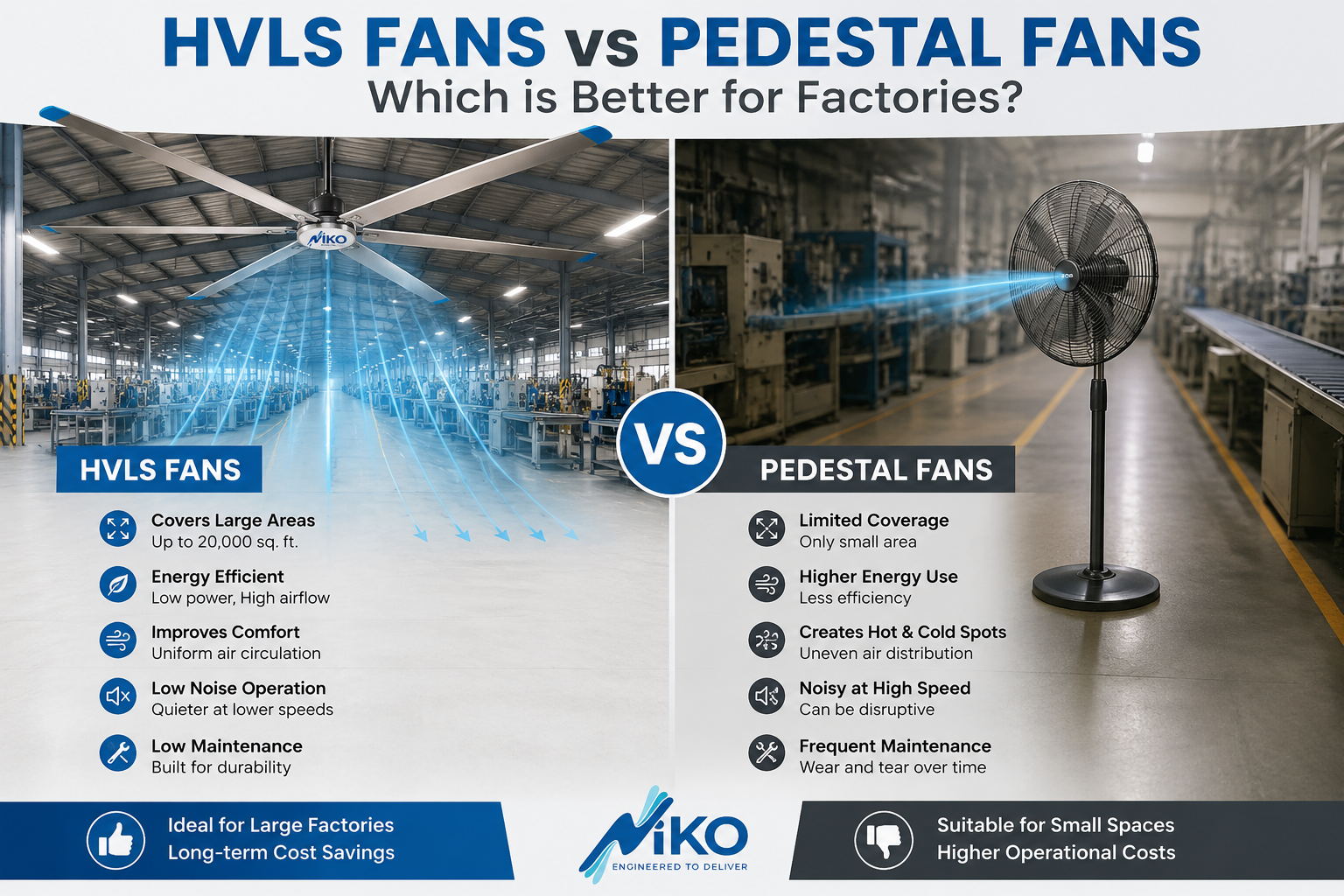
Factories often rely on multiple pedestal fans to maintain airflow. But is that really the most efficient solution?
Let’s compare pedestal fans with HVLS fans to understand which performs better in industrial environments.
Running multiple pedestal fans leads to higher cumulative power consumption.
Factories cluttered with multiple fans often face:
While pedestal fans are cheaper individually, the total cost of ownership (electricity + maintenance) is much higher.
For factories, HVLS fans offer:
👉 Upgrade your factory airflow system with Niko HVLS Fans.
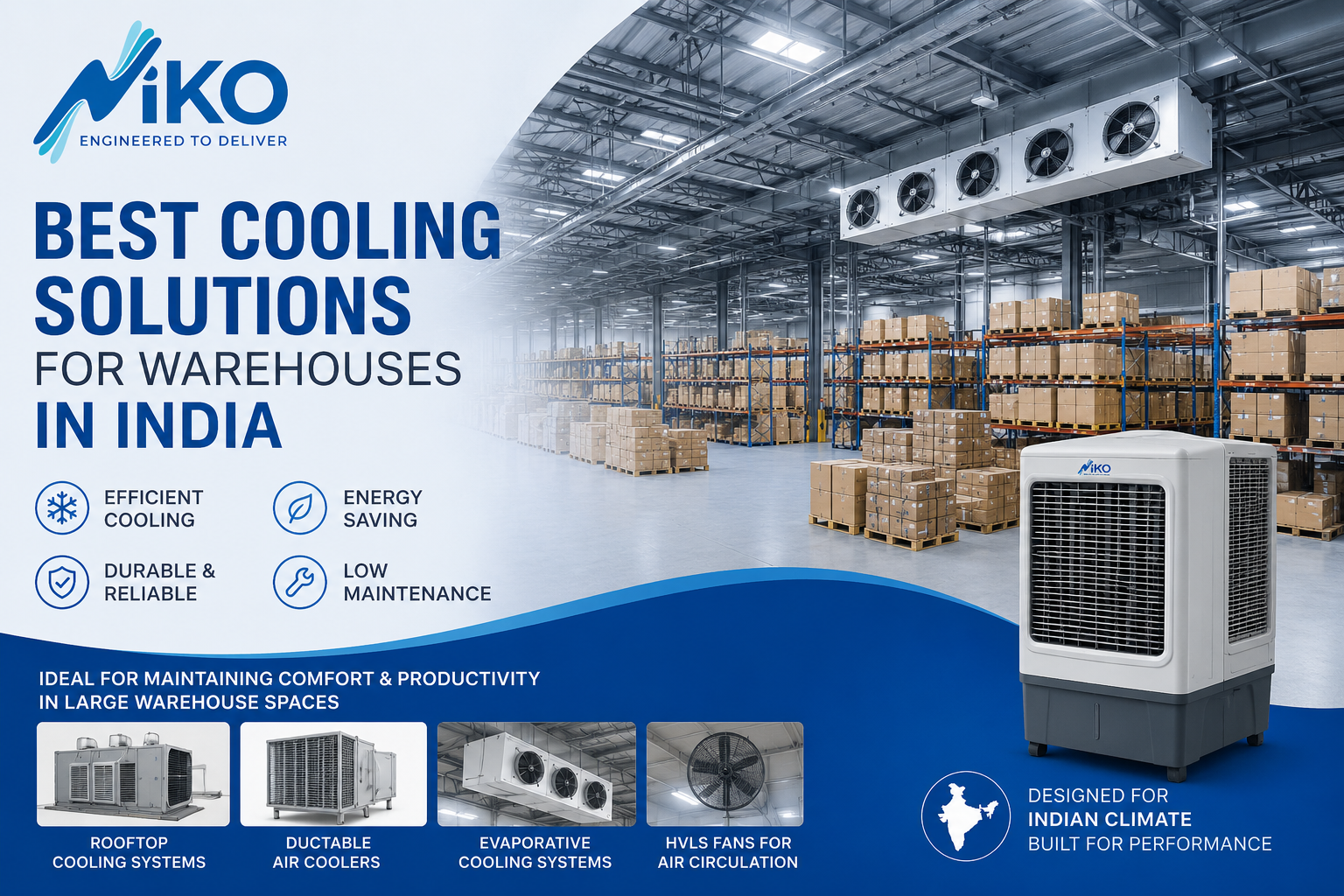
Cooling large warehouse spaces efficiently is a major challenge, especially in India’s climate. Choosing the right solution can significantly impact both comfort and operational costs.
Let’s explore the most common options.
HVLS fans are specifically designed for large industrial spaces.
For warehouses, HVLS fans offer the best balance between performance and cost.
👉 Get a customized cooling solution for your warehouse with Niko Fans.
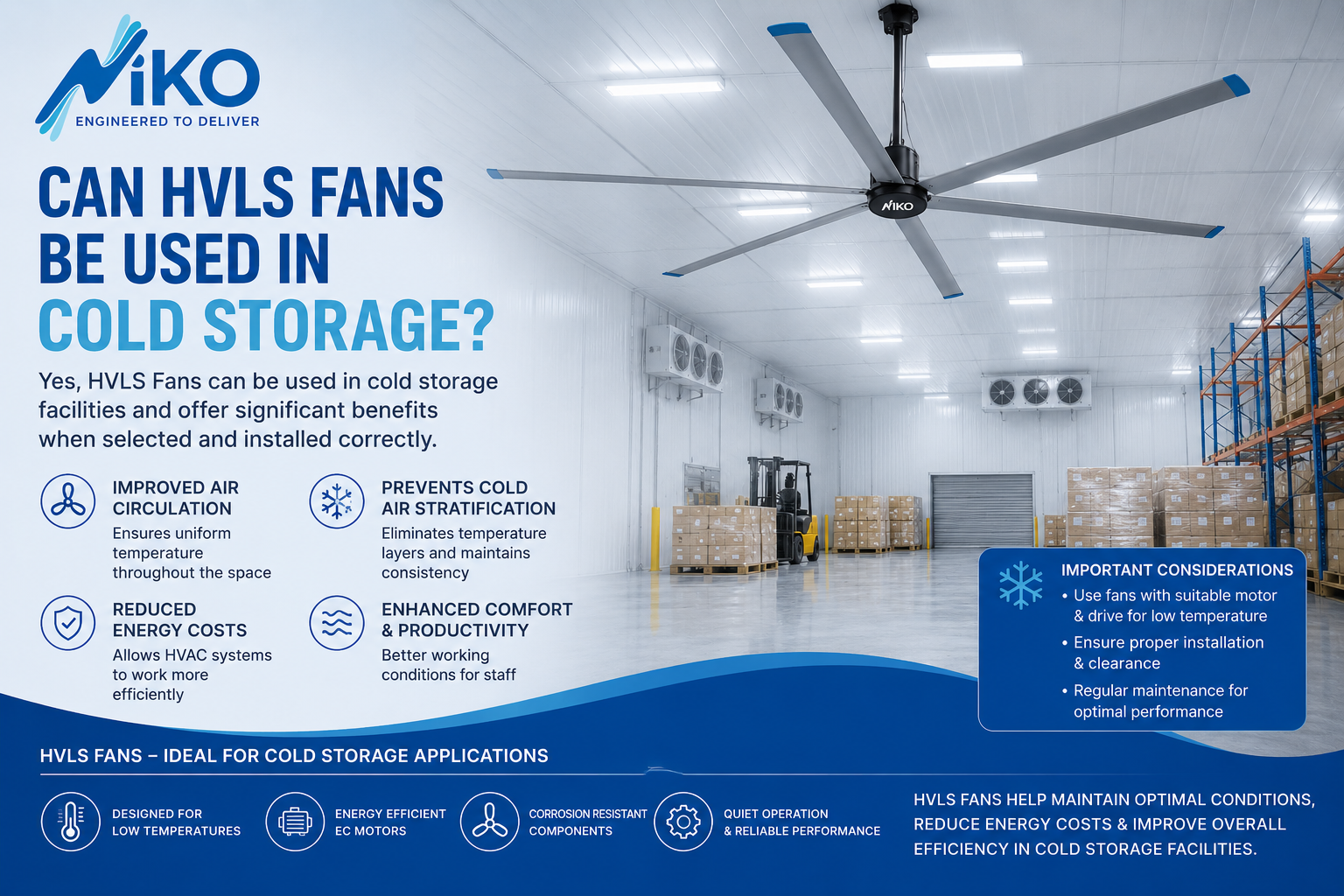
Cold storage facilities require controlled environments, and any airflow solution must be carefully evaluated.
So, can HVLS fans be used in such conditions?
HVLS fans can be effectively used in cold storage, but their application differs from regular environments.
Cold storage facilities often face temperature stratification. HVLS fans help:
Better air circulation allows cooling systems to operate more efficiently, reducing energy consumption.
Proper airflow helps in minimizing condensation and maintaining humidity balance.
In extremely low-temperature zones, fan selection must be highly specialized.
HVLS fans can enhance efficiency in cold storage when designed and installed correctly.
👉 Consult Niko Fans for tailored cold storage airflow solutions.
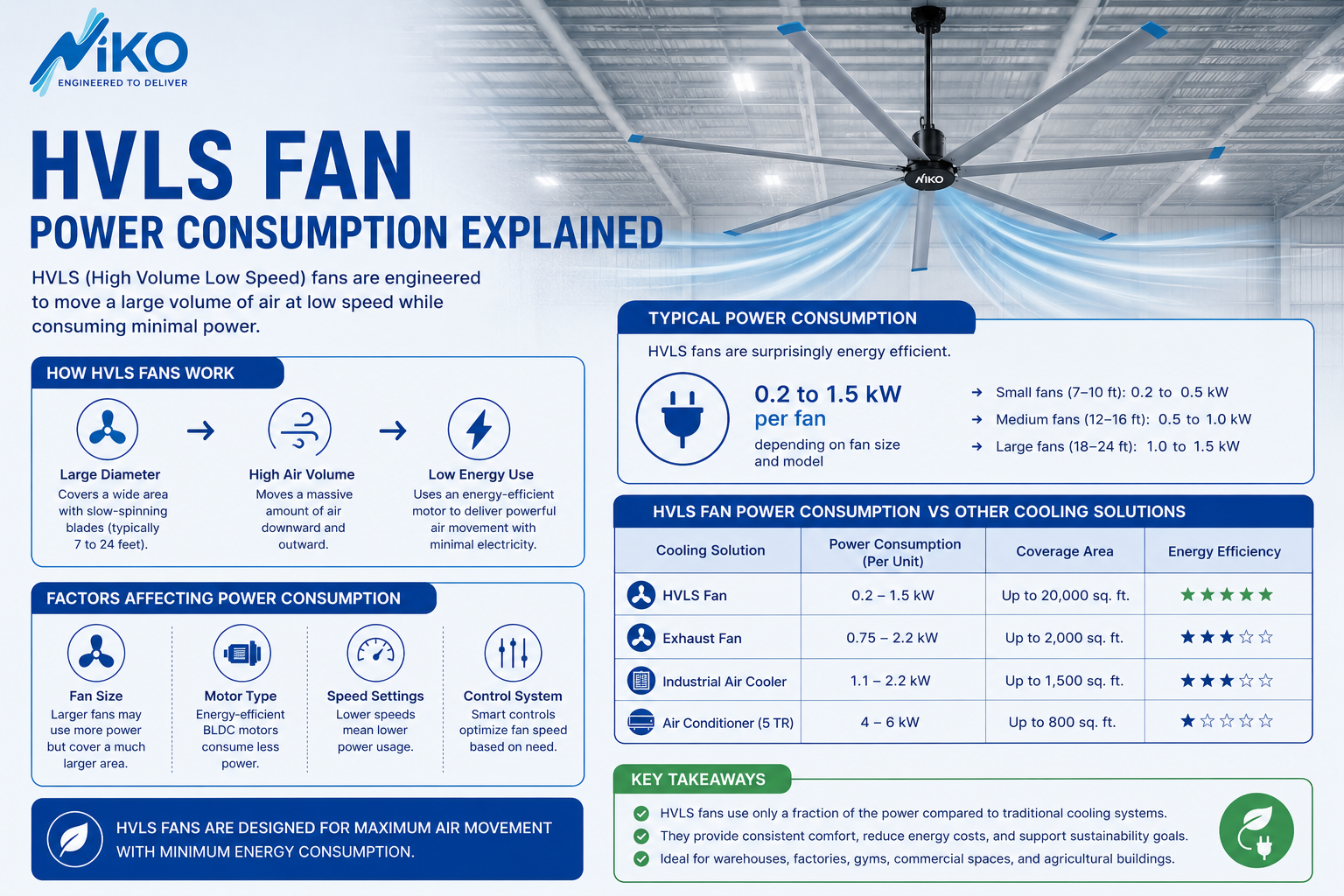
When evaluating industrial fans, power consumption is one of the most critical factors.
Let’s break down how HVLS fans perform in terms of energy efficiency.
An HVLS fan typically consumes between:
Instead of running:
You can use:
Result: 👉 Lower total energy usage
HVLS fans deliver significantly higher air volume per watt compared to traditional fans.
This makes them:
Over time, reduced power consumption leads to:
HVLS fans are designed for maximum airflow with minimum energy consumption, making them ideal for industrial applications.
👉 Want to calculate your savings? Contact Niko Fans for a detailed analysis.
Improve comfort, productivity, and energy efficiency with Niko HVLS Fans from Niko HVLS Fans. Designed for warehouses, factories, commercial halls, and large spaces, our solutions ensure consistent airflow with minimal power consumption.
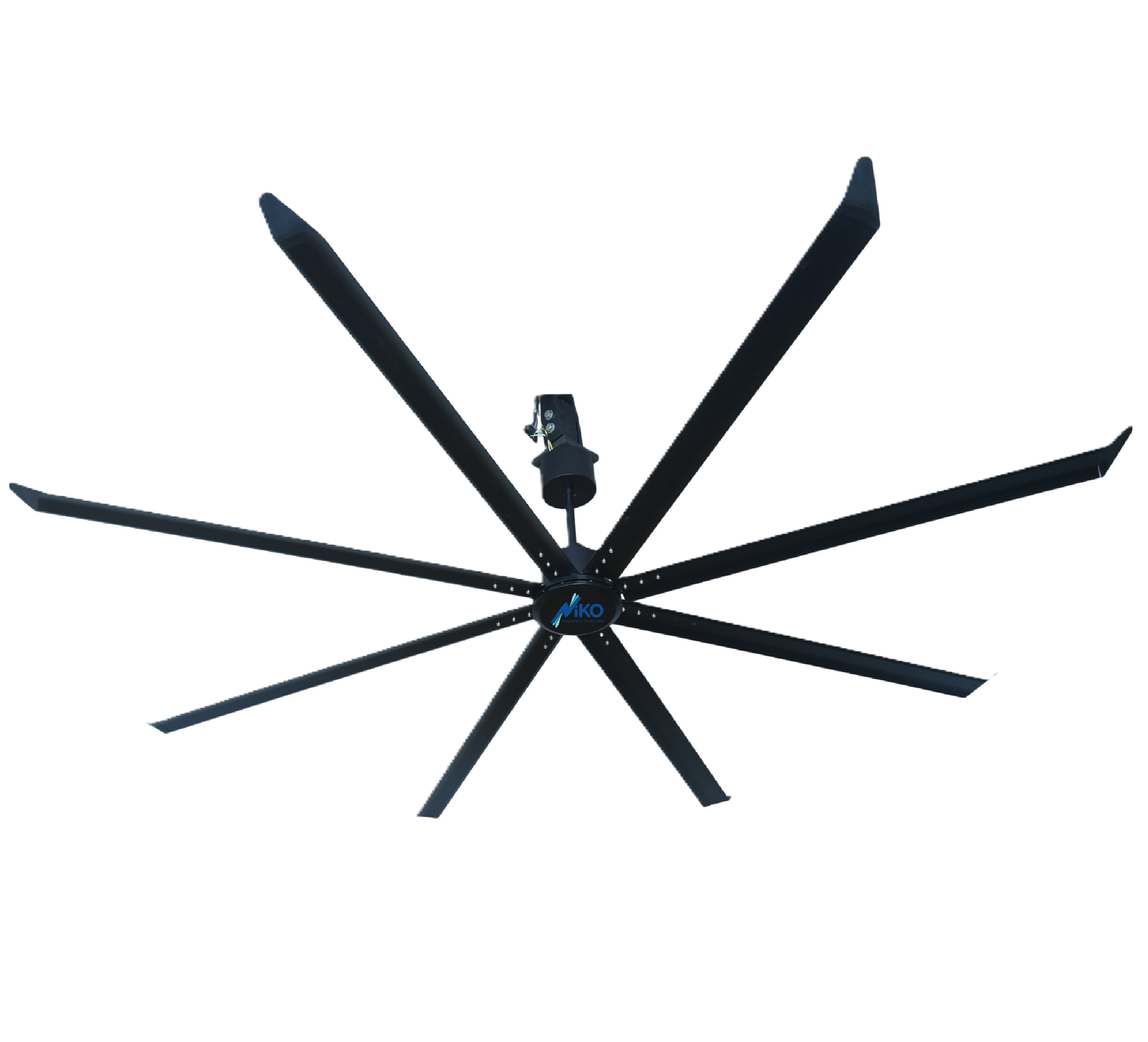
Niko HVLS (High Volume Low Speed) fans move massive volumes of air efficiently across your entire space. What 15–20 ceiling fans struggle to achieve, one Niko fan delivers effortlessly.